Social and Community Context
Home » Health Impact Dashboard » Social and Community Context
People’s relationships and interactions with their neighbors and community can have a major impact on their health and quality of life. When people feel connected and supported by their communities, their health and well-being improve. Strong ties with neighbors, opportunities to get involved, and a sense of belonging can lead to better health and greater upward mobility. On the other hand, people who are socially isolated and lack a sense of belonging within their community tend to have poor health outcomes. The Indy Health District is dedicated to helping residents feel more connected to their neighbors and communities and fostering a greater sense of belonging, ultimately enhancing the health and everyday life of all the people in the district.
Community Social Cohesion
As the Indy Health District works to build a community where every resident has the opportunity to thrive, understanding the lived experiences of those who call the district home is essential. To do this, a community survey was conducted in late 2025 to learn about resident perceptions of social support, their sense of community and belonging, attraction to the neighborhood, civic engagement, and sense of safety. We also asked residents how they rate aspects of the community that the IHD is working to improve (e.g. housing, quality food, childcare). Insights shared by community members will play a critical role in shaping priorities, guiding initiatives, and ensuring that the district grows in ways that reflect the needs and aspirations of its people. Below, we share a few key results from the 2025 Community Survey. To explore the complete findings, view the full 2025 Community Survey report here.
DID YOU KNOW?
Social cohesion—the strength of relationships and trust within a community—can influence rates of disease including diabetes, heart disease, and all-cause mortality. Social cohesion includes residents’ sense of belonging, willingness to help their neighbors, engagement in the community, and holding shared values/norms. Social gathering spots which strengthen community bonds include churches, community centers, parks, and other gathering places.
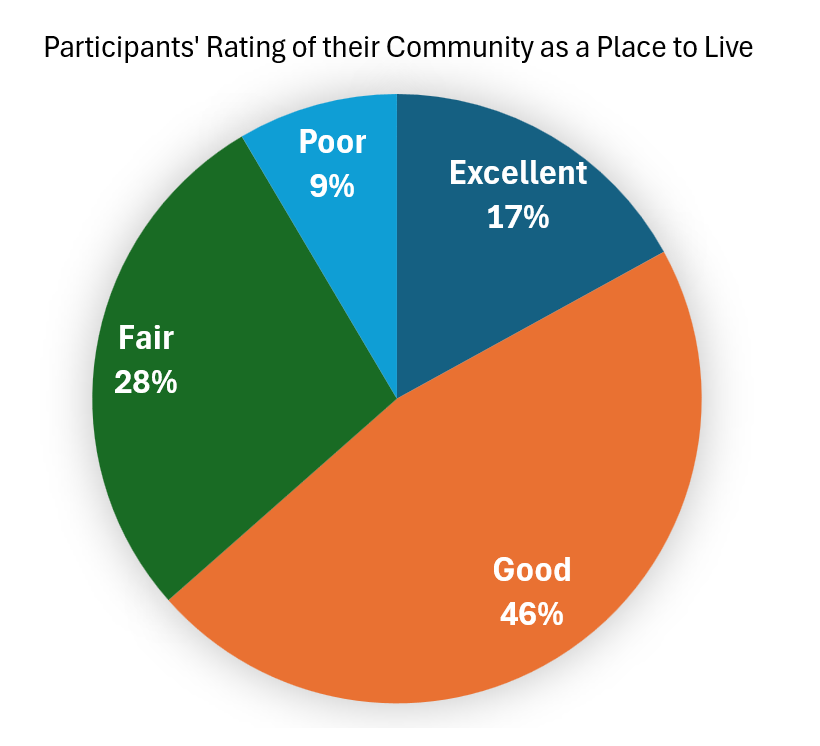
We asked residents about their experiences living in their neighborhood, including how they rate it as a place to live. 63% of Indy Health District residents rated their community favorably (good or excellent).
“The neighbors look out for one another.”
-Community Member from Crown Hill
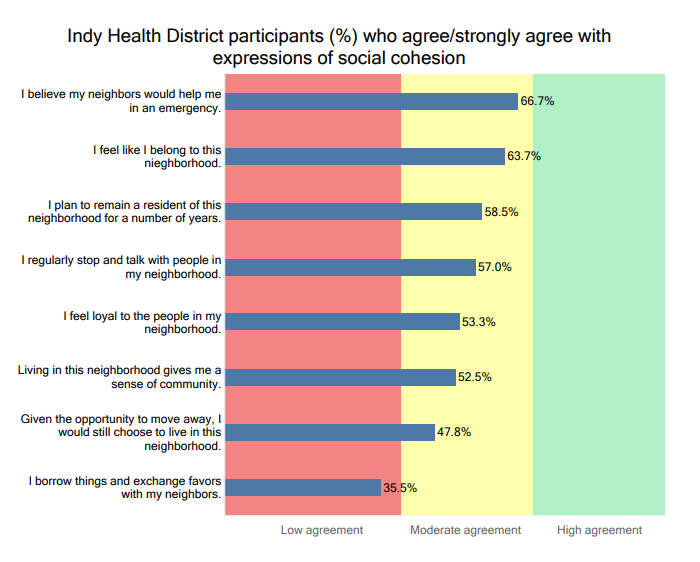
To gauge residents’ perceptions of their neighborhood’s social cohesion, we asked about their level of agreement with 8 statements about their neighborhood. In this chart, we show the percentage of residents who agreed or strongly agreed with each of the 8 statements. They are listed from highest to lowest, revealing relative strengths and weaknesses in residents’ sense of connection, trust and belonging. Generally speaking, the higher the percentage of residents who agree/strongly agree with the statement, the better their view of the neighborhood’s social cohesion for that particular item.
On average, across the 8 items, 54.4% of residents agreed or strongly agreed with these expressions of social cohesion. This signals moderate cohesion or solidarity among residents, but it also means that solidarity could be strengthened. The purpose of measuring social cohesion in the district is to assess changes within the district over time, not to compare to other places.
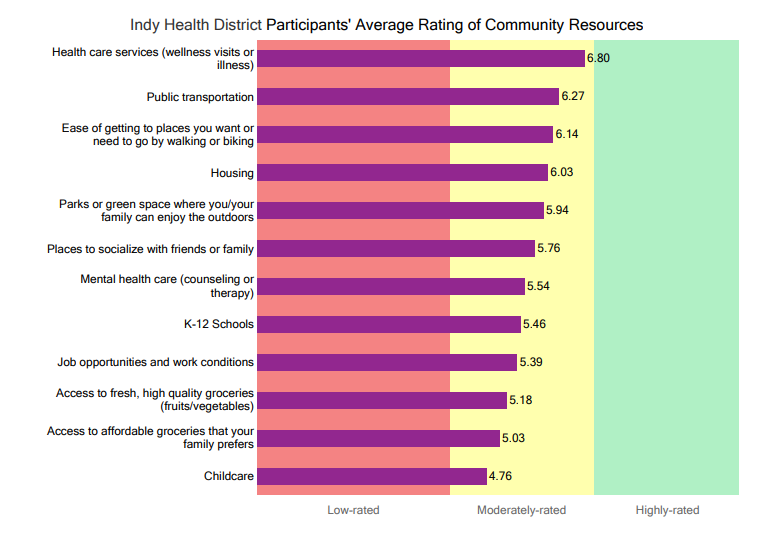
To thrive and be healthy, people need access to basic goods and services in their community and they need them to be of good quality, affordable, and safe. We asked participants to rate 12 key resources from 0 (worst possible) to 10 (best possible). The average rating for each of the 12 resources is shown in the table on the right. They are listed from highest (best) to lowest (worst), so that relative strengths and needs can be identified and prioritized for action. The quality of a resource is considered ‘high’ when the residents’ average rating is between 7.0-10, ‘moderate’ when between 4.0-6.9, and ‘low’ when the average rating is 0-3.9. On this scale, community participants rated each resource as moderate quality, with none rated within the high or low quality range. Health care services were the highest rated resource (6.80), while childcare was the lowest rated (4.76). Please note that these ratings are based on resident’s perceptions of resource quality, not any objective assessment of that resource compared to a set standard.
“This neighborhood was mostly built by WWII Black vets…Many 2nd generation owners are here and are maintaining [those] houses.”
-Community Member from Historic Flanner House Homes
RESIDENTIAL STABILITY
OF RESIDENTS LIVED IN THE SAME HOME ONE YEAR AGO
In addition to the survey findings, indicators such as residential stability, home ownership rates, and vacancy rates can provide additional context on social cohesion in the Indy Health District and are drawn from secondary data sources, not the community survey. Residential stability is the percentage of residents living in the same address from one year to the next. In 2024, 76% of District residents held a stable address.
While mobility can have both benefits (e.g., moving for a better job) and costs (e.g., being forced to move), higher residential stability—meaning the more people living in the same house or address year after year—can indicate stronger rootedness and social ties.
Home Ownership Rate
OF TOTAL OCCUPIED UNITS
Vacancy Rate
OF TOTAL HOUSING UNITS
Home ownership rate—the share of renter- versus owner-occupied homes—often relates to housing turnover and neighborhood attachment, helping to contextualize residential stability. While vacancy rate can reflect normal turnover and housing market transitions, it also shapes how connected and stable a neighborhood feels. High vacancy rates can reduce day‑to‑day interactions and weaken informal social networks.
Note: to see additional data about this metric, click the arrow (< >) on the image below. For more details, hover your cursor or click on points within the image.
Note: to see additional data about this metric, click the arrow (< >) on the image below. For more details, hover your cursor or click on points within the image.
Movement in and out of the Indy Health District
DID YOU KNOW?
Neighborhood changes typically associated with urban development can have both beneficial and harmful impacts on health. (Schnake-Mahl, Jahn, Subramanian, et al, 2020) Thus, monitoring for these impacts is important to the Indy Health District and will inform planning and initiatives.
Community environments are key to trust, connection, support and ultimately quality of life. Initiatives to change neighborhoods by adding businesses, new housing options, and destinations like restaurants or entertainment can lead to long-term residents moving out of the area because they can no longer afford to stay in their homes. The more frequently people move in and out of a neighborhood, the less connected residents feel. Similarly, physical and social changes that occur may alter a neighborhood’s character in unintentional or undesired ways. As a result, long-time residents may move because they no longer have a sense of belonging or connection. The Indy Health District is committed to fostering inclusive development, prioritizing the needs of its residents, and ensuring affordable and high-quality housing. Monitoring patterns of movement in and out of the community is one part of understanding the impacts of development and neighborhood improvements on those who call this area home.
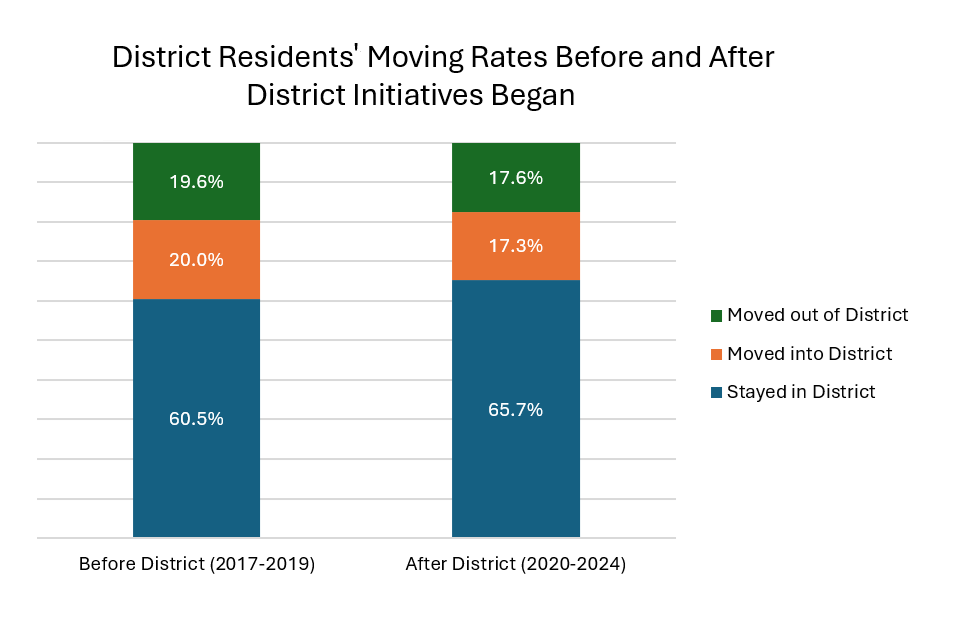
Among people of all ages living in the District who have sought health care in local health systems, we checked for increases in movement out of the District year by year. Our early analysis shows that there has been an increase in residents staying within the District in the years since District initiatives began compared to the years before, increasing from 60.5% (2017-2019) to 65.7% (2020-2024). The Indy Health District is committed to track the ongoing effects of changes in the area on residents and to take action that supports community stability.